DESCRIPTION

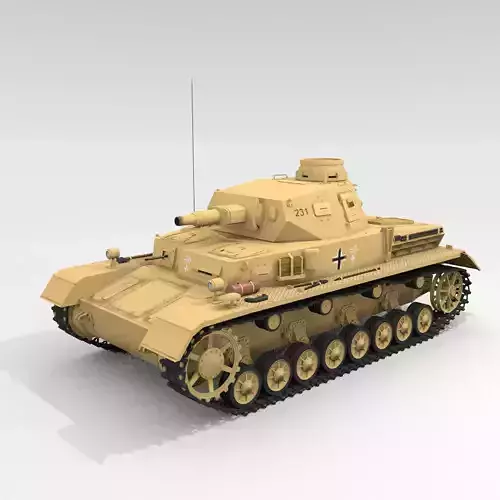
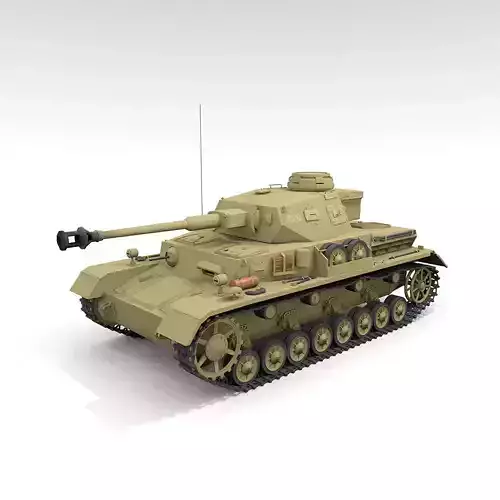
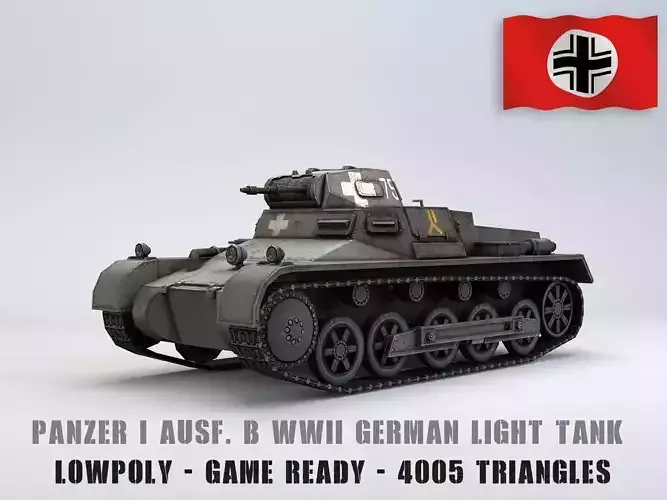
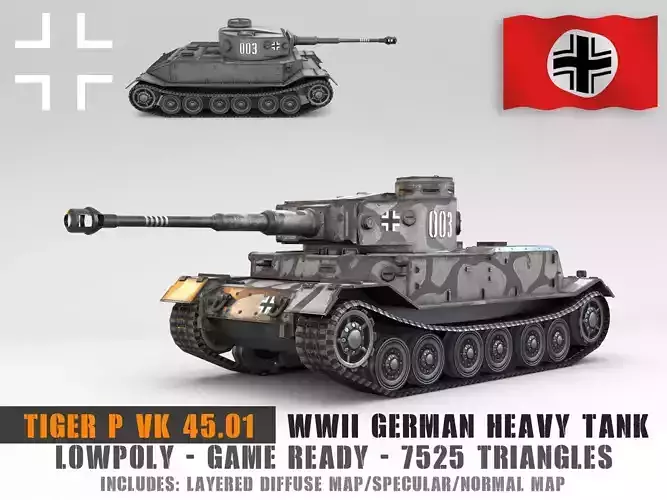
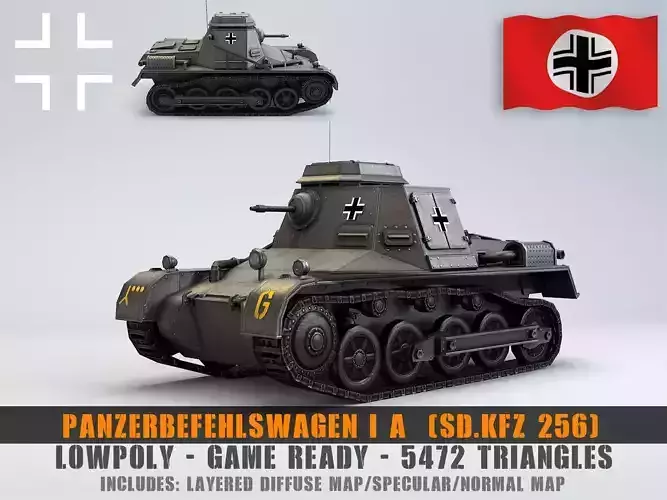
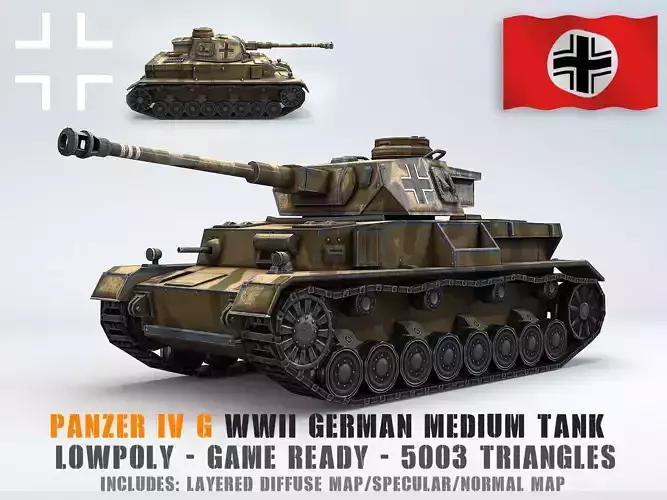
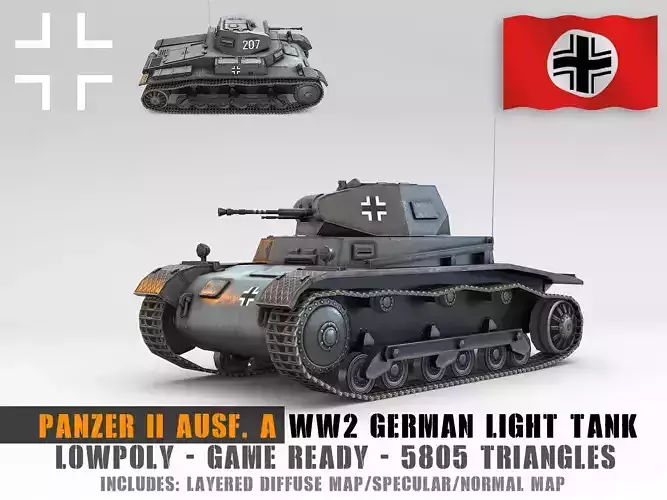
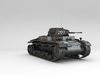
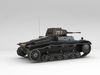
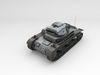
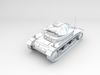
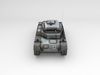
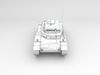
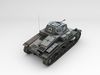
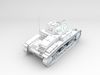
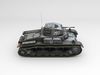
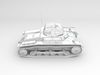
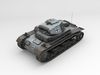
Lowpoly Model of WW2 Sd.Kfz. 121 Panzer II Ausf. A1 german light tank.

Model contains real details and proportions. Textures: 2048x2048 Color map (psd) - AO on layer - color map Normal map 2048x2048, Specular map 2048x2048, Decals - 512x512 , Wheels textures 2k (Color, Normal.Specular) Track texture - mapped suitable for horizontal uv shifting 1024x1024 (Color, Normal, Specular). Separate textures for Exterior, Wheels, Track, Decals

Texture designed for scaling - great for mobile games. Textures can be used in unlit mode

In January 1934 the German tank design office of the weapons testing ordnance department Waffen Prüfwesen 6 (Wa Prw 6) issued specifications of a new tank chassis they wanted built, code name La.S.100. Weapons manufacture Maschinenfabrik Augsburg Nürnberg AG, (M.A.N.) built a prototype La.S.100 tank chassis. They were in competition with two other German companies Fried.Krupp Abt.A.K. and Henschel. M.A.N. was awarded the contract to build the chassis of the new Panzer II light tank based on their prototype La.S.100 chassis. Daimler-Benz designed the superstructure and turret.It is wrong to dismiss the Panzer II tank of 1936 as a poor design when comparing it with more heavily armed and armoured tanks of WW2. The tank’s armour could protect its crew from small arms fire and 7.92 mm S.M.K steel-cored armour-piercing machine gun bullets fired from a range of 30 m. It was designed to engage enemy machine gun nests and destroy them to enable the infantry to continue to advance, not to engage in tank on tank combat. The tank’s 2 cm Kw.K.30 L/55 gun could knock out Soviet T-26 and BT tanks but the crews were aware that the Panzer II tank’s armour would not stop a 3.7 cm or 4.5 cm anti-tank gun.The high nickel-alloy, rolled homogeneous-hard armour plate ranged in thickness from 5 mm to 13 mm. It was welded together not riveted as seen on many other tanks of this time-period. This made it stronger and lighter.The first Panzer II Ausfuehrung (model versions) were given the lower case letter ‘a’ then ‘b’ and ‘c’. Later versions were given capital letters ‘A’, ‘B’ and ‘C’. This can be confusing. The Panzer II Ausf.a tanks was subdivided into Ausf.a/1, Ausf.a/2 and Ausf.a/3. Each version having minor mechanical changes.Early versions of the Panzer II changed shape over time as they were upgraded during their operational life. Additional armour was added and features like cupolas were fitted. Panzer II tanks were not used in the Spanish Civil War. They first saw combat in Poland, 1 Sept 1939.

REVIEWS & COMMENTS

See what other buyers think about this model - real feedback on quality,
accuracy, and usability.
View all
3
0
5
valentin56610
valentin56610Buyer of this model
This user has purchased this specific model
This is doing way worse than the Pz II C on the battlefield, cannot recommend to control, but can recommend to buy !
an
anewaccountBuyer of this model
This user has purchased this specific model
The buyer left positive feedback on this model
bo
born3dBuyer of this model
This user has purchased this specific model
The buyer left positive feedback on this model
Robinson17
Robinson17Community member
This user is part of the CGTrader community
Awesome work....
ka
karluCommunity member
This user is part of the CGTrader community
Great work
cgtdg
cgtdgCommunity member
This user is part of the CGTrader community
nice
BEST PRICE GUARANTEED
Found this model cheaper on another marketplace? Let our support team know - we’ll match it.

Low Poly SdKfz 121 Panzer II Ausf A Low-poly 3D model

Royalty Free License
Hire
Like this model to show appreciation to the designer.
See how many times this model was viewed.
Share this model to support the designer and boost their visibility.
File formats
OBJ
OBJ<br />File Size: 637 KB
FBX
Autodesk FBX<br />File Size: 292 KB
MA
Autodesk Maya<br />File Size: 499 KB
DAE
Collada<br />File Size: 806 KB
TEXTURES
Textures<br />File Size: 79.1 MB
Verified by CGTrader
Verified models are of higher quality as they have
passed CGT Standard technical and visual checks,
making them more professional-grade 3D assets.
Learn more.
FBX
This FBX file has successfully passed the CGT Standard technical and visual checks. The verification results are detailed in the section below.
File & scene
Binary FBX
Binary FBX file is more compact and faster to load and process.
Learn more
No unsupported objects
Unsupported objects:
- Lights
- Cameras
Learn more
Geometry
No N-gons
N-gons are polygons with five or more sides which might cause issues in certain processes like rendering or animation. Learn more
No faceted geometry
Faceted geometry uses flat surfaces without smoothing, which can look unrealistic on curves.
Learn more
Manifold geometry
Manifold geometry ensures all surfaces are properly connected, avoiding issues like edges shared by more than two faces.
Learn more
Textures & material
PBR textures
PBR textures simulate how light interacts with materials, making the model look realistic under different lighting.
Required PBR textures:
- Base Color
- Roughness
- Metalness
- Normal
Learn more
No embed textures
Embedded textures are stored inside the model file, increasing its size and sometimes causing compatibility issues.
Learn more
Square textures
Texture aspect ratio is the width-to-height ratio of a texture. Expected texture aspect ratio: 1:1
Learn more
Power of 2 texture sizes
Textures with dimensions in power of two (e.g. 512x512px, 1024x1024px) are used to optimize performance and memory usage.
Learn more
Assigned materials
Materials are applied to the 3D model to allow visualize a model's surface properties and appearance.
Learn more
UVs & naming
No UV overlaps
UVs overlap when multiple points on the 3D model's surface are mapped to the same point on the UV island causing texture stretching.
Learn more
UV unwrapped model
A UV unwrapped model means its 3D surface is flattened into 2D space, allowing textures to be applied accurately.
Learn more
Allowed characters
Allowed ASCII characters: a-zA-Z0-9-_
Learn more
Provided by designer
Information and details shared directly by the model's designer.
3D Features
The model includes animations (movement or actions) that can be played in supported software or engines.
The model has a skeleton or bone structure, making it ready for posing or animation.
PBR
Uses Physically Based Rendering materials, which give the model realistic lighting and surface properties.
Textures
The model includes image files (textures) that add color, patterns, or detail to its surfaces.
Materials
The model has material settings that define how surfaces look (color, shine, transparency, etc.).
UV Mapping
The model's surfaces are mapped to a 2D image, allowing textures to display correctly.
Plugins Used
Some external plugins were used to create the model. These may be required for full functionality.
3D printing
Indicates whether the designer marked this model as suitable for 3D printing.
Model is not 3D printable
The designer indicates this model is intended for digital use only (rendering, animation, or AR/VR) and not for 3D printing.
Geometry
Polygon mesh
A model built from polygons (triangles or quads) connected in a mesh.
5805 polygons
The total number of polygons (flat shapes) that make up the 3D model.
/ 3467 vertices
The number of points (corners) that define the shape of the model's polygons.
Unwrapped UVs
Publish date
Model ID
Chat